
For years, an IT services pitch often began with people: how many developers, how many support engineers and how many hours a business needed. AI adds a different starting point: which part of the business can run better, and which reusable system can make that happen?
AI for business is moving beyond chatbots toward systems that connect information, prepare actions and complete useful work.
TCS’s recent Porsche and Best Buy announcements make this change tangible. They bring together industry knowledge, existing operations and AI capabilities. The ambition is to connect AI to the way the business operates.
For retail businesses, this raises the possibility of better-connected support, inventory and order workflows. For technology founders, it raises a business-model question: if AI reduces the effort needed for a task, what will customers pay you for?
Understanding that shift requires a few connected ideas: the economics of traditional IT services, the meaning of a repeatable platform, the role of a Global Capability Center, and the ownership of the software and knowledge created along the way.
From billable hours to business outcomes: what is changing?
The traditional services model
In a time-and-materials engagement, a customer pays for agreed hours or team capacity. The provider hires people, develops or maintains software, and manages delivery. Labour arbitrage means serving a market from a location with a different cost base.
That can be a useful arrangement when requirements change or a customer needs specialist capacity. But revenue from a purely hourly engagement is closely connected to the amount of work billed.
Why AI changes the calculation
Consider a simplified example: a task takes ten billable hours. Better tools reduce it to four while meeting the same quality standard. At an unchanged hourly rate, the provider bills less for that task.
The commercial challenge is to decide who benefits from the productivity gain and how the engagement should be priced. A provider can use AI to serve more work, improve margins on a fixed-price project, or offer a managed process whose price reflects the service delivered.
AI does not make all software work effortless. Integration, testing, security and operating responsibility still require attention. It changes the relationship between effort and value.
| Dimension | An effort-based engagement | A reusable AI service model |
|---|---|---|
| Customer buys | Hours, a team or a defined project | An operating capability with defined boundaries |
| Provider’s reusable asset | Tools and delivery experience | Those assets plus configurable workflows, connectors and evaluation methods |
| Growth constraint | More work often requires more delivery capacity | Reuse can reduce repeated development, alongside ongoing operating costs |
| Commercial options | Hourly or project fees | Project fees, subscriptions, retainers, usage or defined outcomes |
| Evidence of value | Delivery and service commitments | Those commitments plus accepted results, time and operating cost |
These models can coexist. The table explains commercial options, rather than claiming that TCS has disclosed a particular pricing arrangement for either deal.
Porsche and Best Buy: two different routes to AI transformation
Porsche and MHP: combining automotive knowledge with AI delivery
On 24 August 2026, TCS announced a five-year strategic partnership with Porsche. It includes a dedicated AI Mobility Centre of Excellence and the proposed acquisition, through a subsidiary, of 100% of MHP, Porsche’s management and IT consultancy. The announced scope spans manufacturing, engineering, operations and customer experience. TCS and Porsche announcement.
An exchange filing puts the five-year services contract at EUR 1.25 billion, effective from the acquisition’s closing date. That is the services contract value, rather than the price paid for MHP. TCS’s contract-value disclosure.
MHP matters because a domain specialist brings knowledge about how industrial operations and systems actually work. Porsche’s own announcement describes MHP’s automotive and industrial expertise, more than 4,500 employees, and a plan for it to retain its brand. The transaction was announced subject to regulatory and competition approvals. Porsche’s announcement.
In business terms, acquiring a consultancy can bring an established delivery organisation and capabilities, rather than rebuilding that expertise project by project. It does not automatically grant rights to every customer’s proprietary technology. TCS’s 8 October update still described the proposed partnership and acquisition as subject to regulatory approvals. Q2 transaction status.
Best Buy: turning an existing capability center toward AI
On 1 October 2026, Best Buy and TCS announced an agreement to transition Best Buy’s India Global Capability Center to TCS. The stated plan combines that team’s retail and enterprise knowledge with TCS’s engineering, AI and delivery capabilities, and transforms it into an AI Capability Center over time. Best Buy and TCS announcement.
TCS also described the ambition for a reusable platform potentially useful to the wider retail industry. That is a stated direction, not confirmation that a finished retail product has already been deployed elsewhere.
The distinction between the two deals is useful. Porsche involves a proposed consultancy acquisition alongside a strategic partnership. Best Buy involves transitioning an existing company operation and developing its capabilities. Both emphasise industry knowledge combined with AI, but their structures differ.
What is a captive GCC, and what changes in an AI Capability Center?
A Global Capability Center, or GCC, is an operation a company establishes to provide capabilities for its wider business, often in another country. “Captive” indicates that it belongs to the company it serves. Such centers can handle engineering, analytics, finance, operations and other specialist work.
An AI Capability Center, or AICC, describes an organisation focused on applying and operating AI capabilities across business processes. In the Best Buy announcement, the transition involves redesigning workflows and developing AI-powered solutions.
The useful change is in the work: a team that understands retail systems can help connect AI to those systems and maintain it as requirements evolve. The label alone does not prove that a center is more productive. Nor does the announcement justify assuming that existing GCCs lack advanced engineering expertise.
What does it mean to industrialise AI at scale?
It means making AI a repeatable part of operations: connecting it to the relevant systems, testing the result, handling failures and maintaining it over time.
A retail chatbot might answer a question about a return. An operational workflow must also retrieve the correct order, consult the relevant policy, prepare the permitted next step, obtain any required approval and record the result.
Four parts make that repeatable:
- Shared infrastructure: connectors, retrieval, access controls, monitoring and model interfaces that multiple workflows can use.
- Workflow design: a defined process with business rules, permitted actions and a route for exceptions.
- Domain knowledge: product definitions, operational constraints and documented decisions that make the process fit the industry.
- Evaluation and ownership: examples of acceptable work, checks for failure and a team responsible for ongoing operation.
These are architectural examples of the idea, not a description of confidential TCS systems.
What is a repeatable AI platform?
A repeatable platform is a reusable software foundation that can be configured for more than one deployment. For retail, that might include catalogue-data extraction, order-system adapters, a review queue and tests for support responses.
The business logic still needs to fit each customer. Reuse can reduce repeated development, but onboarding, integration, inference, support and changes remain real costs.
Automated business processes still need clear permissions, exception handling and someone responsible for their operation.
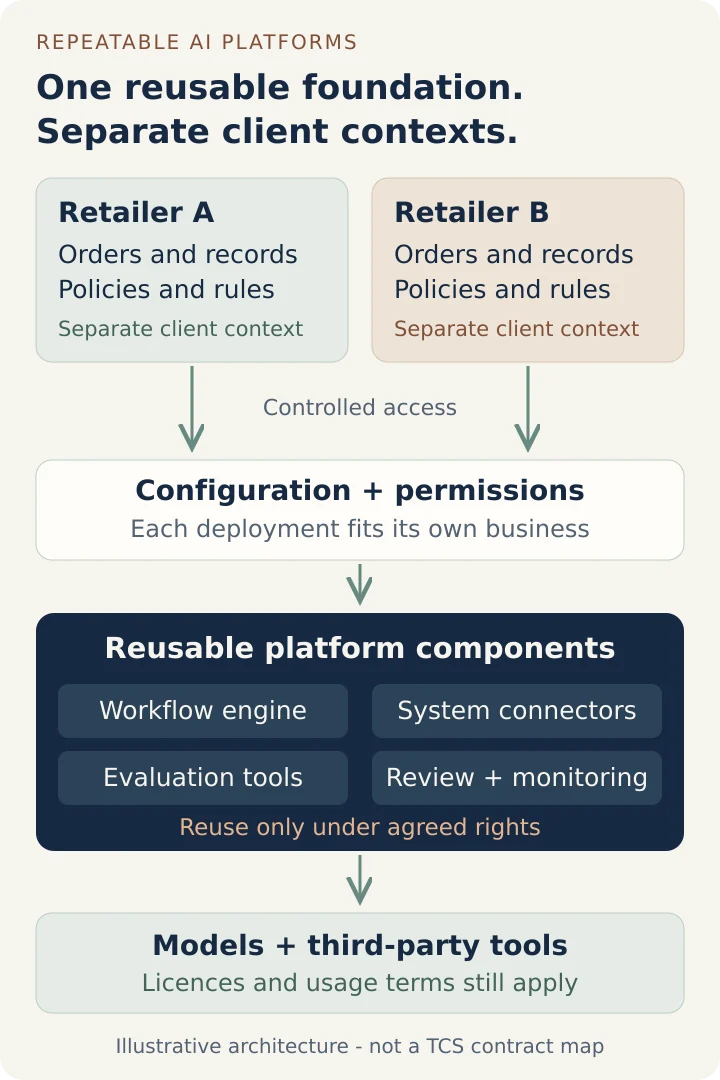
A first deployment can help a provider discover which components are useful more broadly. The next customer benefits from tested components, while bringing its own policies, data and configuration. That is the attraction of an industry platform: accumulated engineering and operating knowledge can improve later deployments.
What is IP in an AI services business?
Intellectual property, or IP, refers to rights associated with assets such as software, documentation, inventions, brands and confidential know-how. In practical software discussions, it helps to distinguish owning an asset from having permission to use it.
An assignment transfers ownership of specified rights. A licence permits use within agreed terms while ownership can remain elsewhere. WIPO explains these distinctions in its guide to IP assignment and licensing.
For example, an agency might build a custom stock dashboard for one retailer under an agreement that assigns the new code. Alternatively, it might license its existing forecasting software and charge separately for configuration. The contract and relevant third-party terms determine what either party can use and reuse.
Which IP rights did TCS retain in these deals?
The public announcements do not disclose a component-by-component IP allocation. They do not establish ownership of particular prompts, retail agents, customer-trained model weights or automotive connectors.
The useful framework is to ask about three categories, rather than assume the answers:
| Category | Examples | What needs to be established |
|---|---|---|
| Client-specific information and assets | Customer records, pricing rules, internal manuals, vehicle designs | Permitted access, confidentiality, usage and any rights in adaptations |
| Reusable software and methods | Existing connectors, workflow engine, testing tools, general documentation | Ownership, third-party licences and the customer’s use and maintenance rights |
| Assets within an acquisition | The acquired company’s software, contractual rights and delivery capabilities | What the acquired entity actually owns or licenses, subject to transaction terms |
In the Porsche case, acquiring MHP would be different from writing software for Porsche under a services contract. MHP’s own assets and rights would matter, but an acquisition does not mean all Porsche designs, customer IP or third-party rights become freely reusable.
In the Best Buy case, the stated ambition for a reusable retail platform makes the boundary between general software and client-specific information especially interesting. The announcement does not reveal that boundary in contractual detail. A generic returns component is a possible example of reusable software; Best Buy’s actual data, policies and ownership arrangements cannot be inferred from that example.
How a smaller IT business can approach the same issue
Before delivery, identify existing software, new client-specific work and third-party components. Then agree the rights for each, including use, modification, maintenance, confidentiality and what happens when the engagement ends.
An agreement can address reusable background software and client-specific deliverables separately. It should also address new components created during the project. Simply labelling something a “framework” does not establish the right to reuse it.
For a retail buyer, the practical questions are whether you can export your information, maintain the integration and move to another provider. For a provider, the question is which permitted components can become a reusable asset for the next project. WIPO on software development agreements.
What this means for retail businesses and new IT companies
Retail businesses: ask for a connected capability
Retailers can automate business processes such as catalogue updates, order handling and customer-support routing. A useful starting point is a recurring task where staff repeatedly copy information between systems or correct inconsistent inputs.
How to automate business processes with AI
Choose a recurring task with a clear input and an observable result. Connect the relevant business systems, define which actions the system can take, and keep refunds, discounts or other consequential changes subject to approval. Compare the cost of a completed, accepted task, including the time staff spend reviewing and correcting it.
This applies whether the solution uses existing commerce software, a custom integration or AI. A smaller retailer can use the platform principle by adopting suitable components around one process, rather than commissioning an entire new technology stack.
IT founders: build expertise and assets around a specific problem
For an IT founder, a useful starting point is an offer more specific than a list of technologies or an hourly rate. For example: preparing product-catalogue updates from supplier documents, with conflicts flagged for a merchandiser to resolve.
Four choices make that offer easier to understand:
- Choose an industry problem. Learn its exceptions, vocabulary and existing systems.
- Define the deliverable. Explain what a customer receives and how acceptable work is measured.
- Retain permitted reusable components. Keep the software and its operating documentation separate from confidential client details.
- Price the work you actually support. Separate implementation, ongoing operation and any usage or outcome charge. If an outcome is billed, define it so both parties can inspect it.
A project can provide both customer value and reusable engineering knowledge. It takes deliberate design and appropriate rights to turn that into a repeatable service. Recurring revenue also carries recurring support obligations.
The opportunity for a smaller business
Retailers want work completed reliably. Technology providers need a sustainable way to deliver that work. Reusable software, domain knowledge and clear operating responsibility can help align those interests.
If your retail or services business has a recurring process that could benefit from better integration and AI, discuss it with AIEstatech. A few representative examples and an explanation of the current process are a useful starting point.
Sources checked on 9 October 2026. Company announcements, explanatory examples and our interpretation are distinguished throughout. The platform diagram is illustrative.